

“Speed” and “freedom” were supposed to be mutually exclusive. Fast bikes were narrow in purpose; versatile bikes weren’t fast. That was the accepted wisdom. But is it really true?
For the four years since I moved to Shikoku, I’ve been wrestling with the same problem. The Nanyo region where I live is a hub of agriculture and forestry, threaded with farm roads. Ride the pavement here and side roads appear at every turn — and beyond them, without fail, there’s gravel. I want to ride the road. I want to ride gravel. I want to enjoy cyclocross too. But no single bike could deliver all of that. I wanted one bike that could do everything.
That’s when Cannondale released the new SuperX. Having ridden every generation of the SuperSix EVO from the first through the fourth, I’ve always been drawn to the forward-thinking nature of Cannondale’s bikes. Could this machine, built primarily for gravel racing, also answer the demands of my daily rides? Could it really reconcile speed and freedom?
I had to find out for myself, so I bought one in August 2025. After roughly four months in the saddle, I want to share everything I’ve come to feel about it.
Reviewer
 | Ryuji (@ryuji_ride) |
text & photo / Ryuji (@ryuji_ride) [PR] edit / Tats (@tats_lovecyclist)
The history and evolution of the SuperX

The original SuperX (2011) was a dedicated cyclocross machine, the bike on which riders like Tim Johnson and Stephen Hyde took national championship titles. In 2022 it was reborn as the SuperSix EVO CX/SE, and in 2024 Lachlan Morton used it to set the all-time fastest record at Unbound Gravel. Still, the naming confusion lingered.
In 2025, the SuperX returns with a clear mission: win at gravel racing — without forgetting its cyclocross DNA.
The new SuperX sheds roughly 100g compared to its predecessor, and the LAB71 version brings the 56cm frame under 900g. It inherits the Kamm-tail tube shapes from the SuperSix EVO, builds flex zones into the seat tube and rear triangle, and uses a D-shaped Aero Carbon seatpost to absorb impacts from the road.
Tire clearance is 51mm up front and 48mm in the rear. The front swallows a 50mm tire with room to spare. The rear is stated at 48mm, but that number accounts for mud clearance — in actual riding, 50mm tires fit fine. Cable routing is fully integrated via the Delta Steerer, and the Out Front geometry pairs high-speed stability with sharp, agile handling.
Technical progress brought refinement of form. The aerodynamic know-how inherited from the SuperSix EVO sculpts the SuperX’s silhouette beautifully. The near-horizontal line of the top tube is a byproduct of the functionality needed to shoulder the bike in cyclocross races. Function dictates form, and that function flows into the beauty of the form itself.
As a machine aimed at the very top of gravel racing, the SuperX has been reborn not only in performance but also in presence.
Why I chose the second-tier build

The gravel bike market has split into two broad directions: race-oriented speed machines, and adventure-focused bikes that prioritize comfort and versatility.
The SuperX clearly belongs to the former camp. Lightweight construction, aerodynamics, racing geometry — everything pursues speed. At the same time, it carries the versatility of accepting tires up to 51C. That coexistence is what makes the SuperX distinctive.
The market offers models that push even further in pure lightness, and others that chase aero to more extreme ends. The SuperX is the balanced choice. It marries low weight with aero performance without sacrificing comfort.
The 2025 SuperX is split into two main grades: the flagship LAB71 frame and the standard frame. Each comes in its own range of complete-bike builds.

| SuperX LAB71 | SuperX 2 | SuperX 3 | |
| Frame | LAB71 SuperX, Series 0 carbon (under 900g at 56cm) | SuperX Carbon (standard frame) | SuperX Carbon (standard frame) |
| Sizes (Japan) | 46, 51, 54 | 46, 51, 54 | 46, 51, 54 |
| Groupset | SRAM Red AXS XPLR (1×13) | Shimano GRX 825 Di2 (2×12, 48/31T, 11-34T) | Shimano GRX 820 (2×12, 48/32T, 11-36T) |
| Wheels | Reserve 40/44 (DT Swiss 180 hubs) | Reserve 40/44 (DT Swiss 370 hubs) | DT Swiss G1800 (aluminum) |
| Handlebar | Cannondale SystemBar R-One (integrated carbon) | Vision Trimax Aero (aluminum) | Cannondale (aluminum) |
| Saddle | Fizik Vento Antares 00 | Prologo Dimension AGX T4.0 | Prologo Dimension AGX STN |
| Complete Weight | 7.4kg (56cm) | 8.5kg (56cm reference) | 9.1kg (54cm) |
| Price (incl. tax) | ¥1,980,000 | ¥1,030,000 | ¥630,000 |
Where the SuperX Sits in Cannondale’s Lineup

Look across Cannondale’s drop-bar lineup and the SuperX’s place comes into sharp focus.
The Topstone is built around comfort and versatility — Kingpin suspension, rack mounts, a more upright geometry. It’s a bike for bikepacking and touring. If adventure matters more to you than outright speed, the Topstone is the answer.
The Synapse is a road bike with gravel ambitions. Tire clearance up to 42mm means it can handle dirt when the road runs out. But at heart it’s still a road bike — a good pick if your riding is mostly tarmac with the occasional gravel detour.
The SuperX sits between the two, but carves out its own territory. Race-ready performance with room for everyday riding. Speed and freedom — that dual nature is what makes the SuperX compelling.
Why We Chose the SuperX 2

The LAB71 SuperX was tempting. SRAM Red AXS XPLR, the SystemBar R-One integrated cockpit, Reserve 40/44 carbon wheels — all for just 7.4kg. A purpose-built lightweight frame wrapped around a flawless race machine.
But I chose the SuperX 2.
The deciding factor was color. Color? You might wonder. Honestly, though, having ridden mostly black frames for years, I simply wanted a white frame again.
There was another reason: room to customize. The LAB71 is too perfect as a complete bike. Anyone who buys it will likely ride it as-is. The SuperX 2 doesn’t really need rebuilding either — the stock Shimano GRX 825 Di2 paired with Reserve 40/44 carbon wheels is an excellent combination, and most people would happily leave it alone. The same goes for the SuperX 3. But by deliberately customizing it, I wanted to build a bike that aligned as closely as possible with my current sensibility and style.
Building the SuperX 2 closer to LAB71

For the drivetrain, I went with a mix of SRAM RED eTap AXS E1 and SRAM FORCE eTap AXS E1. 1x. A 44T front paired with a 10-46T cassette — simple, light, and well-suited to how I ride. Seventy percent on-road, thirty percent gravel. For that balance, 44T was ideal.


I swap wheels depending on terrain. On-road: 28–32C tires on a road wheelset. On gravel: 40C Vittoria Terreno T50 on the Reserve 40/44. Sometimes I’ll go up to 50C. Every tire runs tubeless.

For the cockpit, I switched to the SystemBar R-One (the so-called “MOMO bar”). Cables run cleanly, the look is beautiful, the weight is low, and it absorbs road buzz well. Building a beautiful bike with parts chosen on my own terms — that’s what made it feel like mine.

With the 1x drivetrain swap, new bar, new saddle, and tubeless conversion, the completed bike weighs 7.6kg (without pedals or bottle cages) — virtually identical to the LAB71 complete. About 900g lighter than the stock SuperX 2 (8.5kg).
On the road, on the dirt
How it rides on tarmac

Having ridden every generation of the SuperSix EVO from the first through the fourth, I was genuinely curious about the SuperX on tarmac. Owning both the third- and fourth-generation LAB71 only sharpened that curiosity: how close could a bike that shares Cannondale’s DNA, but is built to handle gravel, get to a pure road bike?

Running 28C tires with a road wheelset, the SuperX makes you forget it’s a gravel bike. Light on its feet, fast. It doesn’t have the razor edge of the fourth-generation SuperSix EVO LAB71, but the aero traits it inherits from the EVO give it a ride that feels distinctly road-bike.

The 44T front paired with the 10-46T rear is a sweet-spot gear ratio. On flats, 44T handles cruising with room to spare — even at higher speeds, you never feel like you’re running out of gear. On climbs, the 46T low cog has your back. Shifting only at the rear keeps things simple, so you can stay focused on the ride itself.

Vibration damping is excellent too. The FlexZone and Aero Carbon seatpost soak up road buzz, easing the toll on your body over long hours in the saddle. Cannondale’s claim — that they’ve “brought back the comfort that was lost on the SuperSix EVO SE” — turns out to be true.

That said, compared with a pure road bike, there are moments where you can feel a slight difference. Weight is on par, but the geometry tells. In sharp accelerations or rolling out of a corner, it doesn’t have the same razor edge — the response lags by just a hair.
But the SuperX is a gravel bike, and its on-road performance is a bonus, not the main event. Seen in that light, this kind of road manner is more than impressive.
On gravel and trails

I head into the gravel on 40C tires with Reserve 40/44 wheels. The SuperX is a high-speed gravel bike — fast goes without saying.
On groomed gravel roads, it holds speed effortlessly. Thanks to the out-front geometry, it’s stable when you push the pace, and quick to turn in.
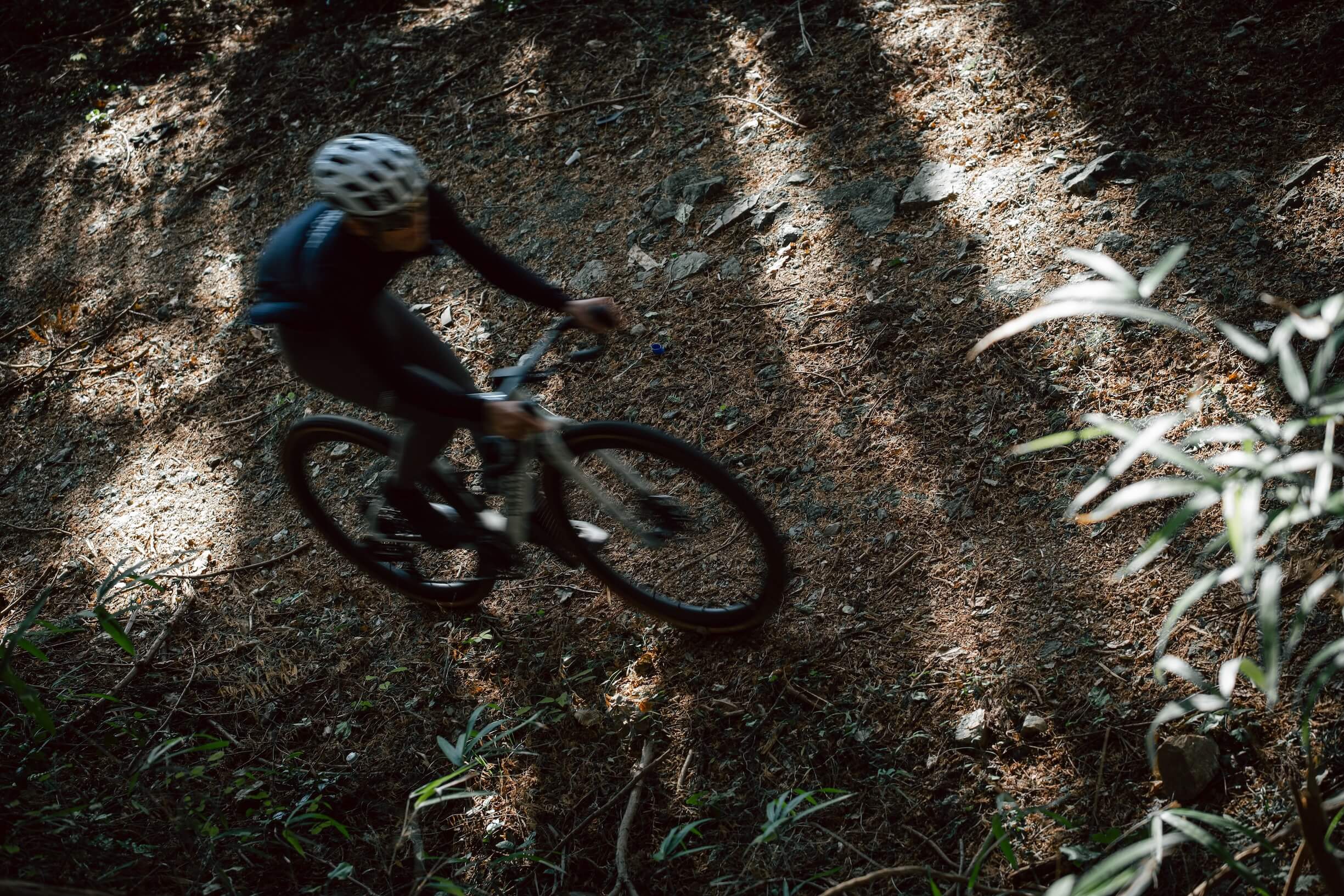
And this is where the SuperX shows its true colors. Small stones and gaps don’t deflect it. You sense the road surface in fine detail while moving fast with very little stress. That’s the FlexZone and Aero Carbon seatpost doing their work — absorbing the hits while keeping the tires planted. The bike doesn’t skip or chatter. You hold your line.

Speed is easy to maintain. That’s what defines the SuperX as a high-speed gravel bike. Even on rough surfaces, your pedaling rhythm doesn’t break, momentum doesn’t bleed away, and fatigue stays low.

My home loop includes plenty of trail-like sections buried under fallen leaves. On terrain like that, I’ll sometimes mount 50C tires. What surprises me is that even with 50C rubber, the handling never feels off. There’s no sluggishness — the bike still moves with purpose. And because the frame is designed with mud clearance in mind, you don’t have to worry about leaves or mud clogging it up. The frame itself is built to welcome big tires. From 28C to 50C, the balance never falters. That’s the breadth the SuperX offers.
Climbing performance

The SuperX is light. After my custom build, it got even lighter. That lightness pays off on climbs, and the 1x44T × 10-46T gearing handles ascents without complaint. With a 46T low gear, you can still push through steep pitches.
The frame’s stiffness follows the same direction as today’s best road bikes — firm and immediate when you put power into the pedals. No power loss to speak of. Yet it absorbs road vibration with quiet competence. Power transfer and comfort, both delivered at a high level.
Climbing posture feels easy, too. The outfront geometry keeps you from loading the front too heavily, making balance intuitive. Even on long climbs, fatigue stays at bay.
Precisely because Japan isn’t Europe or America
One bike, three roles — the multi-wheelset approach

Road bike, gravel bike, cyclocross bike. You could buy a dedicated machine for each. But with the SuperX, swapping wheels and tires lets a single bike play all three parts.
For instance, run carbon wheels for the road, and a separate wide-rim set for gravel. Investing in wheels rather than adding bikes is the smarter move. Storage stays minimal. Maintenance gets simpler.
Fit 28C tires and road wheels, and it works fully as a road bike. Mount 40-50C rubber, and it handles gravel and cyclocross. The frame stays the same. Only the wheels and tires change.
That said, if you’re chasing pure cyclocross racing, take note. The SuperX’s geometry is tuned for gravel racing. Compared to a dedicated cyclocross bike, it gives a little ground in tight-corner sharpness and snap-direction agility. The stability-first design is exactly why it excels at high-speed gravel. Cyclocross is something it “can do,” not something it’s “optimized for.”
This flexibility is the SuperX’s strength — and at the same time, its compromise.
A way of riding optimized for Japan

Japan’s gravel terrain is nothing like Europe or America. Long, maintained gravel roads are rare; instead, forest tracks and farm roads scatter across the landscape. Riding hours on unpaved surfaces as a pure gravel experience is genuinely hard to do here.
Choose a highly specialized gravel bike in this environment, and it only earns its keep on weekends. On weekday training rides, the drag and weight on pavement become a quiet stressor. Eventually, you end up riding only the road bike.
The SuperX changes that. Weekdays on 28C tires for comfortable pavement riding, weekends out on gravel. One bike, every day. None of the pavement drag traditional gravel bikes carry. No sense of weight. That absence of friction is exactly what makes you want to ride it every day.
If you’re choosing a gravel bike in Japan, its time as a pure gravel machine may be limited. But the sheer breadth of what it can cover is reason enough to choose it.
The SuperX is right for you if
・You don’t want to compromise on road or gravel
・You spend most weekdays on pavement but want gravel on weekends
・You’re curious about cyclocross racing too
・You’d rather master one bike than own several
・You don’t want to feel drag or stress on pavement
The SuperX isn’t for you if
・You want to bikepack long distances (no rack mounts)
・You want an upright posture for relaxed gravel cruising
・You’re focused on road racing with zero interest in gravel
“Where shall we ride next?”


Choosing a bike is, in the end, an act of understanding yourself.
After moving to Shikoku, I realized it: I’m not satisfied on the road alone. But gravel alone isn’t enough either. I want both, and at a high level.
Look at Japan’s road landscape, and Shikoku isn’t a special case. Across the country, pavement dominates and gravel is scattered. A highly specialized gravel bike can only shine on weekends. The SuperX is different. You can ride it every day. You want to ride it every day. Without sacrificing specialization, it grasps versatility — and offers an answer.
Where shall we ride next? The SuperX always replies: “Anywhere.”


Cannondale SuperX Model Lineup (Official Site)
text & photo / Ryuji(@ryuji_ride)[PR]
edit / Tats(@tats_lovecyclist)
Related Articles


