

This is a real-world review of Panaracer’s new gravel tire, the GravelKing ZX, written from the media event held in Minami-Aizu in May, to which we were invited by the manufacturer.
Full disclosure: the night before the ride we were treated to incredible food, craft beer, and souvenirs; on ride day there were attentive guides, well-stocked aid stations, and a warm welcome from the locals. It was a wildly enjoyable two days.
So yes, this report is naturally inclined to view the product favorably — but everything you’ll read is what we actually felt out on the road and dirt.
text / Tats(@tats_lovecyclist)
photo / Tats & Panaracer
Day 1: Food, Beer, and the ZX.

On a chilly mid-May evening, we gathered at Minami-Aizu Mountain Brewing’s Beer Fridge — a taproom run by the brewery itself, with locally grown hops featured throughout the lineup of craft beers on tap.

The presentation begins upstairs on the 2nd floor
The GravelKing ZX (hereafter ZX) is Panaracer’s new gravel tire, billed by the company as its “fastest ever on mixed surfaces.” A three-zone tread combines a center slick with sidewall knobs, packing low rolling resistance on tarmac and cornering grip on gravel into a single casing. The lineup currently launches with 45C and 50C, both tubeless ready, with 35C and 40C slated for release this summer.
GravelKing ZX Lineup
| Size | ETRTO | Tread/Sidewall | Weight | Price (incl. tax) |
|---|---|---|---|---|
| 700×45C | 45-622 | ⬛️Black/⬛️Black | 560g | ¥6,930 |
| 700×45C | 45-622 | ⬛️Black/🟫Brown | 560g | ¥6,930 |
| 700×50C | 50-622 | ⬛️Black/⬛️Black | 640g | ¥6,930 |
| 700×50C | 50-622 | ⬛️Black/🟫Brown | 640g | ¥6,930 |

During the presentation, the developers walked us through how they arrived at the new tread pattern, along with detailed test data on grip and rolling resistance. The specific numbers can’t be shared, but under race-relevant conditions, the ZX outperformed leading European brands.

GravelKing ZX (¥6,930)
The ZX’s tread pattern is highly distinctive, divided into three functional zones.
【Center】Slick: A smooth section that minimizes rolling resistance on pavement and hard-packed gravel.
【Inner】Onime-yasuri (rasp-file pattern): Engages during braking and the initial phase of cornering, converting pedaling power into traction.
【Outer】Knobs: Angled in an inverted-V shape to dig in during high-speed cornering and keep the bike under control.

After the presentation, the gathering shifted into a casual mixer over bento and beer — a compact circle of media, distributors, and retailers from across the industry
Day 2: Minami-Aizu Gravel, and the ZX.

The next morning, we gathered at 8:30 at “Hoshippa no Ie,” just below Daiansa Ski Resort, ran through the briefing, and rolled out at 9:30. The route stretched 55km in total, with more than 30km of that on gravel.

Anna and Tats joined from the LOVE CYCLIST editorial team, riding a Specialized Crux (45C) and Canyon Grizl (50C) respectively

Gravel kicks in the moment we roll out
Bears frequent this area, so the guide fires a pistol along the route to scare them off before any unwanted encounter.
Every rider also gets a Trendy Shokai bear bell. Being guided by a local cyclist and absorbing this kind of regional context is something you rarely get from a typical event, and that alone raises the anticipation.

The Trendy Shokai bear bell, ringing all day long


And then, straight into a climb
The surface kept shifting. Singletrack, doubletrack, fine gravel, coarse stones, sticky mud, and the occasional sudden stretch of tarmac. Flat gravel barely existed; we threaded our way through rough mountain terrain. It’s a far cry from the open expanses of European or American gravel races, but it was an ideal proving ground for measuring every characteristic of the ZX.

The pace was quick. As you’d expect from a group of industry insiders, everyone had solid legs. Stops were short, and we moved with rhythm (the threatening skies also pushed us to keep things tight).


Pure delight at the hospitality
Mid-route, locals set up an aid station, serving up regional vegetables, meats, and more. It was ridiculously good. On a normal gravel ride you’d of course carry your own fuel, but here the guide, the food, the bear deterrents, the support car — everything was taken care of. You could ride empty-handed and just focus on riding. Hospitality gravel. We’d love to see more user-facing events like this. It lowers the bar to entering gravel.


The gravel kept getting rougher, yet not a single rider ran into trouble

The route mixed in tarmac too. The paved climbs hit hard — precisely because we know what a road bike feels like up them


At the open square that served as our lunch stop, local kindergarteners welcomed us with a taiko drum performance. They were close in age to my own kids, so I couldn’t help but smile. This is hospitality gravel at its finest.

Rain clouds rolled in and the temperature dropped sharply
After lunch the rain started, so we hurried back. The downpour came and went in heavy bursts — no chance to shoot — but even on the wet descents the tires held their line without a hint of slip.

Finishing caked in mud
ZX Impressions

Because the test course covered every imaginable surface, the ZX’s strengths and weaknesses came through with real clarity

The benefit of the center slick is obvious on tarmac and packed gravel. It rolls properly, and you can feel it gather speed with conviction.

That said, when I put down torque on steep, rocky sections, the tire would occasionally slip. That’s the trade-off you accept the moment you choose a center-slick. You just have to adapt — pick a different line, change how you put the power down.
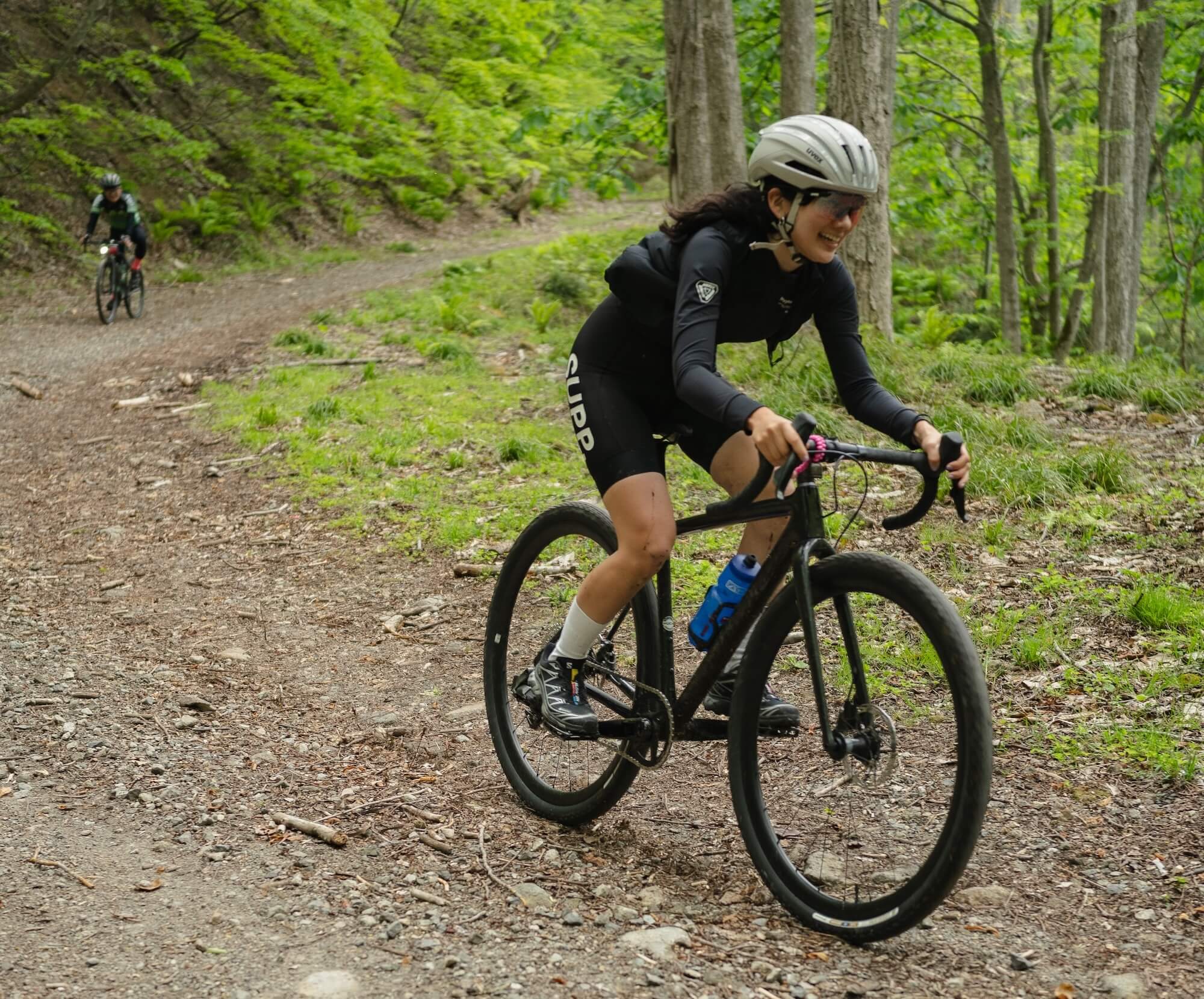
The uniquely shaped side knobs, however, bit into the ground far better than I expected. Even leaning the bike hard through descents, there was no fear of losing the line. The V-shaped, outward-splayed design — as explained in the previous day’s presentation — is engineered to maintain precise traction, and across the entire test ride I never once felt the tire put me in a dangerous position. The GravelKing name is well earned.

Since I was running the 50C, the weight did become noticeable on pavement. If your route is mostly tarmac, going 45C or below would probably be the smarter call. But on gravel, the 50C felt vastly more reassuring than a 40C or 45C, so the right size really comes down to the terrain you ride.

Honestly, for a technical course like the one we rode, I’d personally pick the X1 (in fact, my own gravel bike is fitted with X1s).
But the ZX will absolutely earn its place under riders who want one bike to cover both road and gravel duties, or for those chasing race pace and fast-gravel ambitions.
Minamiaizu, I’ll be back.


Beyond the hospitality from Panaracer and the locals, the location itself — Minamiaizu — was breathtaking. The variety of surfaces, the easy access to gravel, the mountain ridges seen from the passes, the rice fields spread across the valley floor. “This is exactly what I was looking for,” I must have said out loud a dozen times. On the paved roads home, after getting dropped solo from a too-fast lead group, the beauty of those rural landscapes quietly brought tears to my eyes. I’ll be back, on my own time.
Panaracer is reportedly planning more cyclist-focused events in Minamiaizu following this one. When that happens, I hope you’ll join in and experience this remarkable place with your whole body.

Buy the GravelKing ZX (Amazon)
text / Tats(@tats_lovecyclist)
photo / Tats & Panaracer


