

Cannondale’s SuperSix EVO has been renewed for the first time in three years, arriving as its fifth generation (Gen 5).
Honestly, most riders will glance at it and wonder, “what’s actually new?” The EVO’s platform was completely overhauled at Gen 4, and the visual leap from Gen 4 to Gen 5 is subtle. Those well acquainted with Gen 4 might catch the finer details, but most differences only emerge in a side-by-side comparison.
And yet Hiroko, who has been riding the Gen 4, tells us that Gen 5 elevates the joy of cycling even further than its predecessor. So what has actually changed? We explore the answer through what she looks for in a bike.
Reviewer
 | Hiroko Has ridden the Cannondale SuperSix EVO Hi-MOD (Gen 4) since 2024. She owns four bikes (road, gravel, steel, and a mini-velo), using each according to the day’s purpose. A lover of the mountains, she’s just as fluent in traversing the Northern Alps and carving turns as a certified ski instructor as she is on two wheels. A past OMM champion, with a sharp eye for map reading. |
review / Hiroko[PR]
edit & photo / Tats
*This review is based on extended real-world testing of a bike loaned by Intertec, Cannondale’s Japanese distributor.
Playing Outside, and the Bike

Hiroko lives in central Tokyo, but grew up in an environment where playing outside was simply the default. As an adult, she dissolves into the open air through every means she can find — not just cycling, but mountaineering and skiing too.
“On weekdays I work in the city, and I commute on a Brompton. Moving by bike, you pick up on all sorts of things — the shift in the air’s chill, the colour creeping into the street trees. Between the two inorganic points of home and office, a gradient of colour starts to emerge. That sensation is what I love.”

Commuting on a Brompton ©Chabeck
Daily rides keep her in touch with nature. Beyond that, she walks the banks of the Tama River on weekdays, runs in the lead-up to events like the OMM (a mountain adventure race) — no fixed training regime, but a habit of moving her body in whatever way the next event calls for.

Hiroko’s team at the OMM ©OMM JAPAN official
Weekends, on the other hand, are reserved for something further from the everyday — hiking, skiing, the road bike, or the gravel bike. In winter it’s backcountry on the snowy peaks; the rest of the year, mountain hikes, road riding, or gravel.

“Hiking and skiing involve loading up serious gear and heading deep into the mountains — they feel more like ‘expeditions.’ The road bike, by contrast, is an extension of daily life, the most accessible of all the activities. The moment I step out the front door, I’m already going, and that line carries me straight into the extraordinary.
You can enjoy it year-round, and because it tells you exactly how your body is doing, it’s also become my benchmark for checking my own condition. Gravel sits somewhere between the road and the mountains — there’s a joy in not having to choose your road, in pushing further into nature.”
What we actually want from a road bike

Hiroko once said that if she had to rate the fun of riding a road bike on a five-point scale, it would be a “2.” Isn’t that a little low? we teased her among friends — but her answer comes down to the fact that cycling, for her, is an extension of everyday life.
Pursuits like mountaineering or skiing, built entirely out of the non-everyday, easily earn a “5” on that same scale — and that makes sense. The pure, untouched landscapes that open up on a mountain; the fear of dropping into backcountry powder, overwhelmed by an even bigger rush of exhilaration. These aren’t the choreographed experiences of a familiar cycling route — they’re rewards found inside uncertainty.
But the kind of fun we seek when overcoming the unknown is fundamentally different from the kind we seek when simply extending our daily life onto two wheels.

“Basically, I love riding with friends. It’s less about grinding myself into the ground solo, and more about hanging on for dear life behind faster riders, taking in great scenery, and eating good food along the way. Distance doesn’t really matter to me — whether it’s 30km or 100km, what I value most is sharing that time on the bike with everyone.”
Because that’s her style of riding, the road bike she wants has to be measured by one thing: does it amplify that kind of joy?

“I’m drawn to simple, clean frames — something close to a horizontal silhouette — and honestly, choosing a bike starts with how it looks for me. My current EVO (Gen 4) immediately made the shortlist because of its shape, but once I rode it, I quickly realized the performance was on another level too. I could suddenly hang with faster friends I’d never been able to keep up with before, and riding became so much more enjoyable. Part of why I chose EVO was that I’d always wanted to try a pure racing road bike at least once. But beyond competing in races, I think there’s real meaning in choosing a racing model simply for the standard it sets — riding comfortably and confidently alongside everyone else.”
Was Gen 4 already the finished article?

Her impression of the Cannondale brand itself has also shifted over the past few years.
There was a time when Cannondale felt louder — a brand that announced itself as race machinery. But since the logo update, she sees it as a more grown-up product, one that sits naturally alongside her lifestyle and the muted tones of the kit she usually wears.

Gen 4 EVO
“I’ve been riding the EVO (Gen 4) for more than two years now, and I really feel the quality of how it rides. The straight-line stability is exceptional — it almost feels like the bike wants to roll forward on its own when you put down power, which is something I’d never experienced on previous bikes. It climbs properly too. On gradients around 5%, you can just spin steadily and it keeps moving you up. The black finish looks sharp, and it pairs perfectly with my PNS kit. Until I rode the Gen 5, I had no complaints whatsoever — honestly, I kept thinking, what else even needs updating?”
The Gen 4 EVO she thought was already complete — and yet, just three years later, the Gen 5 has arrived. What does it actually feel like once you grip its bars?
“The shape hasn’t changed at all”

“My honest first reaction was, ‘The shape hasn’t really changed.’ But when you look closely, every bit of noise and every hard edge has been carefully stripped from the frame. The surfaces are incredibly smooth, and precisely because the change isn’t loud, I found myself drawn to a presence that feels even more refined than the Gen 4.”
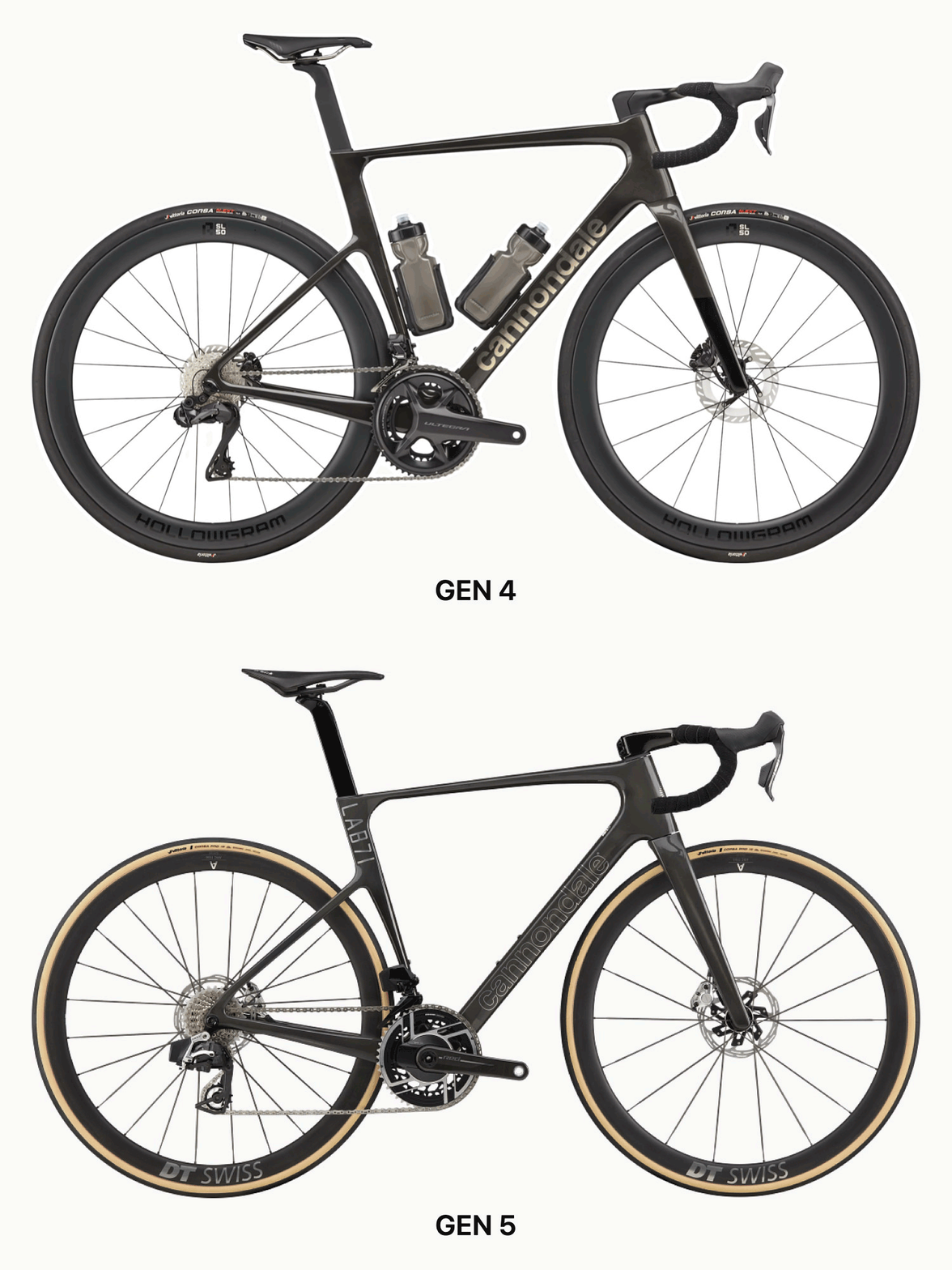
Compared side by side, the changes become visible — most clearly in the thicker head tube, the lower stack height, and the more steeply sloping top tube.

The once-angular tube shapes have been refined into smoother, more flowing forms

In line with current trends, the head tube has grown thicker

The top tube slopes a touch more steeply than on Gen 4, allowing more seatpost to be exposed — and with it, more flex to absorb the road

The gold line running along the handlebar and top tube is a beautifully judged accent — it harmonizes with every colorway across the lineup

“From the very first pedal stroke, you could feel it was different. This isn’t just about being faster or lighter — it’s as if the quality of the riding experience itself has been lifted to another level.
There’s no lag between intent and response — it’s that ‘horse and rider as one’ sensation. The bike answers honestly to your inputs; it doesn’t run away on its own, it accelerates with your body. Tasting that unity made me feel, all over again, ‘ah, riding a bike really is wonderful.'”

We all remember the first time we threw a leg over a real sports bike and thought, “wow, it really moves like this?” The G5 brings that wide-eyed feeling back.
The G5 was developed under the directive of “lighter, faster, stiffer — evolved on every front.” On paper, the deltas may look like marginal gains stacked up into modest numbers. But what actually arrived in the world carries something more: a sense of being “more natural, more refined.”

The new SystemBar Road handlebar is another win. With the size 54 now defaulting to a 360mm width, bike control feels far more intuitive. On Gen 4 the stock build came with 420mm bars, forcing Hiroko to swap them out for 380mm — on Gen 5, no such change is needed from the start.

With the lower stack, it almost feels like a slightly smaller size. A longer stem would likely deepen the sense of unity with the bike even more.

Gen 5 accelerates more smoothly through the mid-speed range, leaving no weak spot across any tempo.

On climbs, the change was harder to detect — confirming that the EVO’s true character lives in the mid-to-high speed range.
“The Synapse I reviewed before felt like riding on a carpet — that reassuring sense that it would carry you anywhere. Riding solo, the Synapse would definitely leave me with more in the tank. But the EVO’s sharpness when you stomp on the pedals, that light, lively rhythm — it’s just a different animal. For my style of riding, where I want to push my heart and lungs to the limit alongside my friends, the EVO’s responsiveness is the better fit — that was reconfirmed for me.”

Synapse LAB71
There’s no hierarchy between the Synapse and the EVO — only a difference in direction. When the question becomes which one fits your style, Hiroko picks the EVO.

“Before I rode the Gen 5, I had zero intention of replacing my bike — but now I’m wavering. Once I rode it, I just wanted it… It’s a race bike, but it’s not that rough, stiff kind of ride. It feels controllable, it’s genuinely fun to ride — that sensation is so fresh. Of course you’re going to want one after a test ride like that.”

Hiroko’s test bike is sold as a frameset only (¥670,000). The understated gold finish is gorgeous — “If I went with the Gen 5, this is the color I’d want,” she said.

This time around, the Standard Mod is also offered as a frameset (¥330,000), and the colorway is just as appealing. If you’re choosing by color alone, both the Hi-Mod and the Standard Mod are on the table.
Back to when it was pure


Value that specs alone can’t capture. For Hiroko, who embraces multiple athletic pursuits, the Gen 5 EVO is more than just an equipment update — it’s a partner that heightens her senses. Rather than chasing dramatic change, she reads the refinement living in the details and elevates the quality of the ride itself. That very process is what makes outdoor play, lived as an adult, so rewarding.
“Riding is simply fun” — the latest racing machine brings back that pure exhilaration we felt when we first got our hands on a sports bike. The pursuit of performance ultimately leads to emotional richness, and that sense of horse-and-rider unity makes our lifestyle all the more vivid.


Cannondale SuperSix EVO (Official Site)
review / Hiroko
edit & photo / Tats
[PR] provided by / Intertec Inc.
Related Articles


